 Near

Leave a Light
A wordless act of presence. It does not ask the other person to solve anything or begin a long exchange.
Sometimes you know exactly who you want near and still cannot find the sentence. Near gives that moment a smaller first step: leave a Light, choose one line, or write only what you can manage.
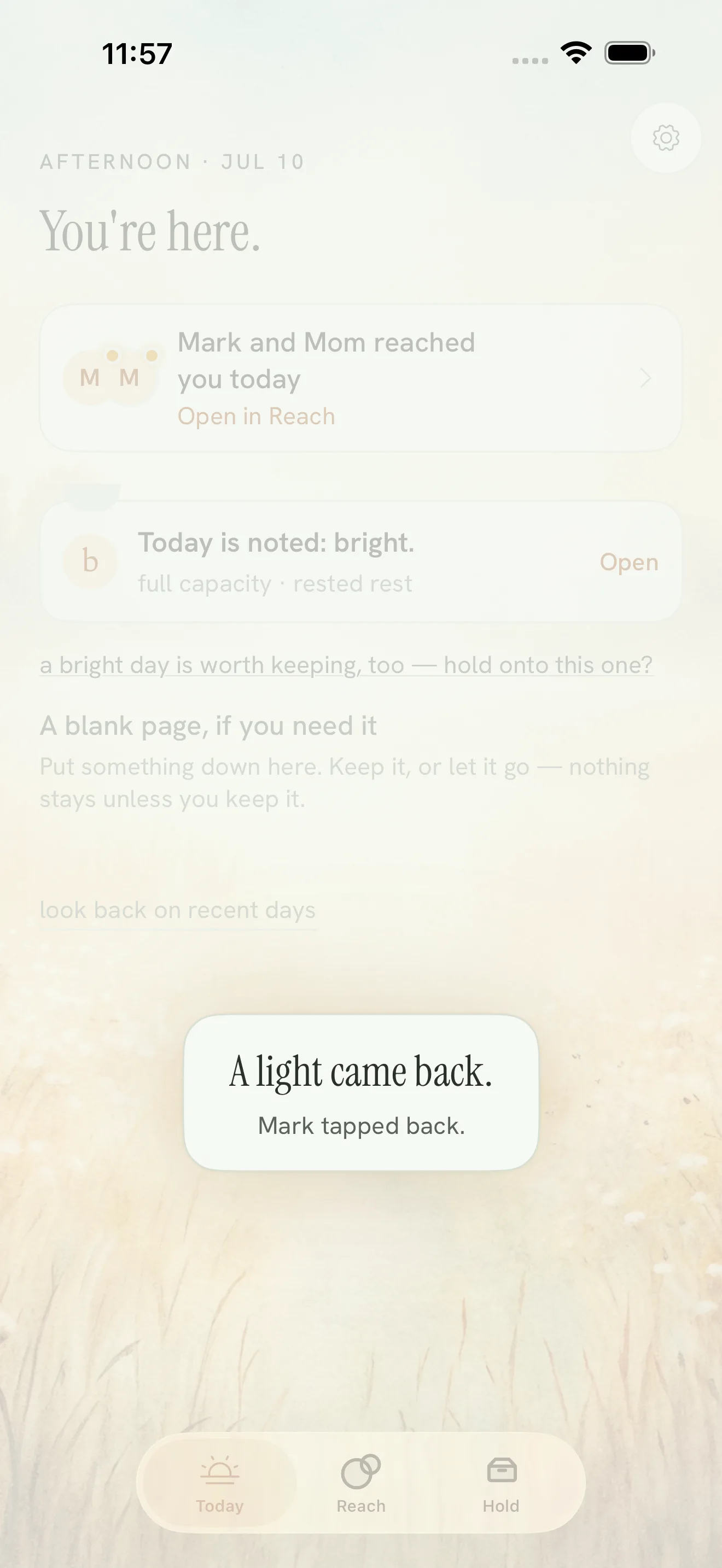
A wordless act of presence. It does not ask the other person to solve anything or begin a long exchange.
Use a short line when forming your own words feels like the hardest part of reaching out.
Near has no read-receipt pressure or response debt. A small deliberate answer can be enough.
Near is not only for difficult moments. A joke, a photo, a quiet “thinking of you,” or a Postcard can live in the same one-to-one bond. That ordinary use is what makes the space familiar when words become harder later.
It does not diagnose, score, predict, or decide how serious a moment is. It helps you deliberately turn toward someone you chose.
Reach and Hold are separate. What you keep privately in Hold stays yours unless you deliberately select something, review the outgoing act, and send it to someone. Near does not quietly turn private notes into relationship signals.
Near can be used with a partner, close friend, sibling, parent, or anyone else you trust. The app does not require a public identity, a follower graph, or a relationship label to decide who matters.